
Make Your Own Earrings in Toronto
Last updated: April 26, 2026.
The short version
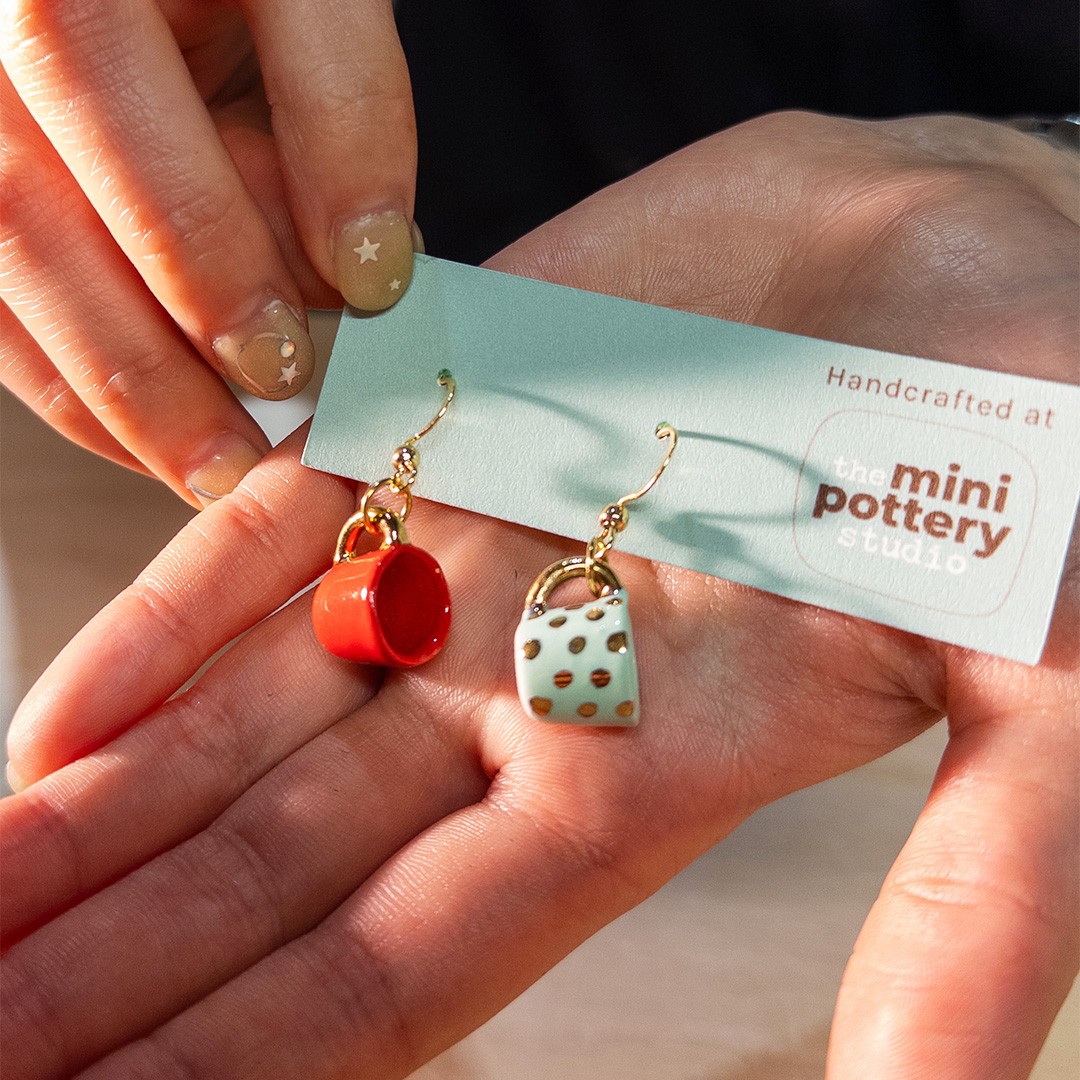
What: A 2.5-hour beginner Ceramic Jewelry workshop in Toronto. You make porcelain earrings (and a few pendants or charms if you want), the studio kiln-fires and assembles them.
Take-home: 6–8 finished pieces — typically 3–4 pairs of earrings plus extras.
Price: $99 per person. All porcelain, glazes, surgical-steel posts and hooks, and assembly included. No soldering, no torchwork.
Where: 4909 Yonge Street, Unit 2 — a 2-minute walk from Sheppard-Yonge station in North York, Toronto.
What does "make your own earrings" mean in Toronto right now?
If you search "make your own earrings Toronto," almost every workshop on page one is sterling silver. The format competitor — Harbourfront Centre's "Make Your Own: Simple Earrings" — runs three hours, costs $190, and produces one pair of silver hoops. That's the dominant pattern across the city: silversmithing, soldering or torchwork, one finished pair.
The Ceramic Jewelry workshop at Mini Pottery Studio sits in a different category. It's $99 for 2.5 hours, you work in porcelain instead of metal, and the typical student leaves with 3–4 pairs of earrings plus a couple of pendants or charms — 6–8 finished pieces total. No other Toronto workshop on page one produces more than one pair in a session.
That structural difference — porcelain instead of silver, slab cutting instead of soldering, several pairs instead of one — is the whole pitch. The rest of this guide covers how the earrings actually get made, what the hardware looks like, and how the price compares.
Can you make earrings without soldering?
Yes. Porcelain, polymer clay, and bead-stringing all produce finished earrings without any soldering, torchwork, or metal-heating tools. You only need soldering when the earring body itself is metal — sterling silver, gold, or precious-metal clay (PMC).
The Ceramic Jewelry workshop at Mini Pottery Studio is the no-soldering option for people who want a real, kiln-fired piece. You shape the porcelain, cut the earring blanks, texture them, and pierce the holes for hardware. The studio handles bisque firing, glaze, glaze firing, and final assembly with the hooks, posts, or jump rings you choose. For a wider comparison of porcelain vs. polymer vs. metal clay, our Ceramic Jewelry workshop guide covers all three formats side by side.
How earrings get made in the Ceramic Jewelry workshop
Earrings start as a flat slab of porcelain, get cut into paired shapes, get textured, and get pierced for hardware — all in the first 90 minutes. The studio handles glazing, kiln-firing, and final hardware assembly from there.
The 2.5 hours run like this: a 20-minute demo with the porcelain and a tray of example pieces from previous cohorts, then about 45 minutes rolling out slabs and cutting paired earring shapes (discs, teardrops, arches, asymmetric blobs), then 45 minutes texturing with lace, leaves, stamps, or rolled-up fabric, then a final stretch piercing the holes for hardware and choosing your posts and hooks from the studio's tray.
Most students walk out having made 3–4 earring pairs and a couple of pendants or small charms — 6–8 pieces total. The take-home count is unusually high for a Toronto jewelry class because porcelain pieces at this scale are small and slabs run efficient.
Mini Pottery Studio is Toronto's first studio focused on mini ceramics — earring-scale work is the studio's native format, not a side offering. The workshop is designed and taught by Cielo Vianzon, MPS co-founder and miniaturist artist — featured on Netflix's Best in Miniature with brand commissions for Sephora Canada, Zara Home, Fenty Beauty, and Heineken US. Tiny-format ceramic is Cielo's practice; the earring techniques in the workshop are the same ones she uses on commissioned brand pieces.
How do you design matched pairs vs. complementary mismatches?
Matched pairs come from cutting both halves at once from one slab; complementary mismatches come from making the two earrings deliberately different — same colour family, same texture, different shape. Both are valid and both are taught.
For matched pairs, the technique is to roll a slab to even thickness, then cut the first earring and the second from immediately adjacent porcelain so they shrink to the same size during firing. Hand-cut earrings will never be perfectly identical — that's part of the look — but matched pairs from one slab read as a set. For complementary mismatches, cut two different shapes (a disc and a crescent, say) but texture them the same way and pick the same glaze. The asymmetry reads as intentional, and the people who lean into it tend to go home with more interesting earrings than the people chasing exact symmetry.
What about hardware and sensitive ears?
The Ceramic Jewelry workshop uses surgical-steel posts and hooks as standard, which most people with sensitive ears tolerate well. Porcelain itself is hypoallergenic — there's no metal contacting the back of the lobe except the post or hook.
The studio's hardware tray includes surgical-steel hooks (for dangle earrings), surgical-steel posts (for studs), jump rings to connect the porcelain piece to the hook, and dangle chains if you want length below the piece. If you're making earrings for someone with a nickel allergy or a known reaction to costume jewelry, mention it before class so the right hardware gets matched in.
How much does it cost to make your own earrings in Toronto?
Toronto pottery and jewelry workshops range from about $35 to $200+ per session. For earrings specifically, the city's options cluster into three price bands: ceramic at $99 (MPS), silver/metalsmithing at $150–$200, and polymer-clay home kits at $25–$60. The take-home count is what makes the price-per-pair comparison stark.
Workshop | Material | Duration | Price | Earring pairs home |
|---|---|---|---|---|
MPS Ceramic Jewelry | Porcelain (kiln-fired) | 2.5 hours | $99 | 3–4 pairs + extras (6–8 pieces total) |
Harbourfront Centre — Make Your Own: Simple Earrings | Sterling silver | 3 hours | $190 | 1 pair |
Polymer-clay home kit (Etsy / Sculpey) | Polymer clay | Self-paced | $25–$60 | Varies — you supply hardware |
At $99 for 6–8 finished pieces, MPS effectively works out to $12–$16 per piece. Whether it's the right format depends on what you want: one heirloom-quality pair of solid silver hoops calls for a silversmithing class, but several pairs of porcelain earrings to keep, gift, or swap with the season is what the ceramic workshop is built for.
Earrings as a gift — making 3–4 pairs in one afternoon
The Ceramic Jewelry workshop is a useful experience-gift format: it produces wearable, gift-able pieces the student made themselves. With 3–4 pairs finished per session, most students keep one pair and give the rest.
That math doesn't work in a silver workshop — one pair of silver hoops at $190 is a personal piece, not a gift batch. The ceramic format lets you make a pair for yourself, a pair for a sister, and a pair for a friend's birthday all in one afternoon, for the price of a single silver workshop. If you'd rather give the experience itself, gift cards are available at minipotterystudio.kilnfire.com.
What is the Premium Gold Lustre add-on?
Premium Gold Lustre is a real-gold finish applied as a third firing after the regular glaze fire — actual gold suspended in a medium that bonds to the porcelain in the kiln. For earrings specifically, it works well as a thin gold rim around a disc, a single gold dot on a plain piece, or on one earring of an asymmetric pair (so the second earring becomes the "fancier" one).
Add it at checkout or on the day. Gold-lustre kiln loads go in less frequently than regular glaze loads, so pickup runs longer than the standard 3–4 weeks, and the finished gold needs gentle handling — no abrasives, no ultrasonic cleaners.
Where to find us
Mini Pottery Studio is at 4909 Yonge Street, Unit 2, in the Willowdale neighbourhood of North York — about a 2-minute walk from Sheppard-Yonge station on the Yonge corridor. Take the TTC; the studio is on the second floor on the east side of Yonge. Free street parking is usually available on weekends.
"This class was the perfect creative escape — the studio felt warm and inviting." — Google review
Frequently asked questions
Can you make earrings without soldering?
Yes. Porcelain, polymer clay, and bead-stringing earrings all skip soldering entirely. The Ceramic Jewelry workshop at Mini Pottery Studio is the no-soldering, no-torchwork option for people who want a real kiln-fired piece — you shape and cut the porcelain, the studio handles firing and hardware.
How much does it cost to make your own earrings in Toronto?
The Ceramic Jewelry workshop is $99 for 2.5 hours and produces 6–8 finished pieces (typically 3–4 pairs of earrings plus extras). Silver and metalsmithing workshops in Toronto run roughly $150–$200 for 3 hours and produce one pair. Polymer-clay home kits cost $25–$60 but you supply the hardware.
Can I make matching earring pairs?
Yes — most students make at least one matched pair. The technique is to cut both halves from immediately adjacent porcelain on the same slab so they shrink to the same size during firing. Hand-cut pieces will never be perfectly identical, which is part of the look.
Will my ceramic earrings be heavy?
No. Porcelain at earring scale is light — most pieces fire to a few grams. Ceramic earrings made in this workshop are noticeably lighter than equivalent stoneware or polymer-clay pieces, and considerably lighter than solid silver.
Are the earring posts hypoallergenic?
Yes. The studio uses surgical-steel posts and hooks as standard, which most people with sensitive skin tolerate. Porcelain itself is hypoallergenic. If you're making earrings for someone with a known nickel allergy, mention it before class so the right hardware gets matched in.
Can I gift the earrings I make?
Yes — the take-home count of 6–8 pieces is high enough that most students keep one or two pairs and gift the rest. Gift cards for the workshop are also available at minipotterystudio.kilnfire.com if you'd rather give the experience.
What is the Premium Gold Lustre add-on?
A real-gold finish applied as a third firing after the regular glaze fire. It adds metallic detail to part of the piece — a rim, a dot, a line. Pickup runs longer than the standard 3–4 weeks because gold-lustre kiln loads go in less frequently.
The short version, again
3–4 pairs of porcelain earrings + extras in 2.5 hours, for $99 — no soldering.
Surgical-steel hardware included; porcelain itself is hypoallergenic.
Beginner-friendly. Designed and taught by Cielo Vianzon.
Ready to book? See upcoming sessions and reserve your spot for the Ceramic Jewelry workshop. For the wider material comparison, the Ceramic Jewelry workshop guide is the cluster hub. If earrings aren't the only piece you want to make, our parallel guides cover making your own jewelry in Toronto, making your own necklace, and making your own bracelet. New to MPS? Start with what to expect at your first pottery class, or browse every class we run.